What are sinking funds? How to stop yearly bills from wrecking your month
October 25, 2026 · 6 min read
Most months you know what is coming. Rent, the phone, the car payment, groceries. Then November arrives with car registration, the dentist wants $240 for a filling, and there are nine people to buy Christmas presents for. None of it was a surprise. It just was not in the budget, because it does not happen every month.
A sinking fund fixes that. It is a small amount you set aside every month (or every paycheck) for one specific cost you already know is coming, so that when the bill lands the money is already sitting there.
What is a sinking fund, exactly?
A sinking fund is savings with a name and a due date. “Christmas, $600, by December 10” is a sinking fund. “Savings” is not. The name tells you what the money is for, and the date tells you how fast you need to fill it.
The term comes from old company accounting, where a business would put money aside every year to pay off a bond when it came due. Your version is the same idea at kitchen-table size: divide a big, predictable cost into small pieces and pay yourself first.
Sinking fund vs emergency fund vs bill buffer
These three get mixed up all the time, and mixing them up is how people end up raiding the emergency fund for Christmas.
- Sinking fund: for a cost you know is coming. You know the rough amount and the rough date. Car insurance every six months, school photos, a wedding in June.
- Emergency fund: for things you cannot plan. A job loss, a hospital visit, a transmission. You hope never to touch it.
- Bill buffer: the cushion in checking that covers the gap between when a bill is due and when the paycheck lands. We wrote a whole post on how big your bill buffer should be.
If you could have written the date on a calendar a year ago, it belongs in a sinking fund.
Common sinking fund categories
You do not need twenty. Start with the three that hurt most last year. If you are not sure which those are, scroll back through last year’s bank statements and look for the months where you ran short. The cause is usually on this list:
- Christmas and birthdays
- Car registration, inspection, tires and oil changes
- Car or home insurance if you pay it every six or twelve months
- Back to school: clothes, supplies, fees, sports sign-ups
- Annual subscriptions (Amazon Prime, Costco, software, a domain name)
- Medical and dental copays, glasses, contacts
- Vacation or a trip home for the holidays
- Pet costs: vaccines, grooming, the yearly vet visit
- Property tax if it is not in your mortgage
How to work out how much to save
The math is one division. Take the amount you need, and divide it by the number of months (or paychecks) left before you need it.
Christmas, starting at the end of October
Last year you spent about $600 on gifts, food and wrapping paper. It is October 25, and you want the money by December 10. That is three paychecks if you are paid every two weeks: October 30, November 13 and November 27.
$600 ÷ 3 = $200 a paycheck. If $200 is too much, that is useful to know now and not on December 20. Either trim the list to $450 ($150 a paycheck) or start next Christmas’s fund in January at $25 a paycheck, which adds up to about $600 by next December.
That last line is the real trick. A sinking fund started late is expensive. The same fund started eleven months early is small enough to forget about.
Car registration and tires
Registration is $180 every March, and the tires will need replacing next fall at about $700. That is $880 over roughly twelve months, or about $74 a month. Paid every two weeks, it is $34 a paycheck.
Where to keep the money
Keep it somewhere you can reach in a day or two but will not see every time you buy coffee. For most people that is a separate savings account at the same bank, or a high yield savings account. Some banks let you make named “buckets” inside one savings account, which is handy if you have more than two or three funds.
One account holding several funds is fine, as long as something keeps track of how much of the balance belongs to each fund. That “something” can be a notebook, a spreadsheet or your budget. What does not work is a single savings balance with no labels, because then every dollar in it looks available.
Put the transfer on payday, not at the end of the month
This is where most sinking funds quietly die. You plan to move whatever is left at the end of the month, and at the end of the month there is nothing left.
Move the money the day the paycheck lands, before the spending starts. Better still, set an automatic transfer for that day. If you get paid every two weeks, tie each fund to the paycheck instead of the calendar month, the same way we suggest budgeting biweekly paychecks one pay period at a time.
If your income moves around, set the transfer to a small fixed amount you can always hit, and top it up in good weeks. There is more on that in our guide to budgeting with irregular income.
What to do when you spend from a fund
Spending the money is the point, so do not feel guilty about it. When the registration bill arrives, move $180 back from savings to checking and pay it. Then check two things:
- Was the estimate right? If registration went up to $195, raise next year’s amount now while you remember.
- Is anything left over? Leftovers can roll into next year’s fund, or into a fund that is behind.
If a fund runs short, borrow from another sinking fund before you touch the emergency fund, and write down what you borrowed so you pay it back.
A simple way to start this week
- Pick the three yearly costs that caught you out last year.
- Write down the amount and the month for each one.
- Divide each by the paychecks you have left until then.
- Set up the transfers for your next payday.
- Add the next three once those feel normal.
The short version
- A sinking fund is savings with a name, an amount and a due date.
- Amount needed ÷ paychecks left = what to set aside each payday.
- Move the money on payday, not at the end of the month.
- Start next year’s Christmas fund in January, and it costs about $25 a paycheck.
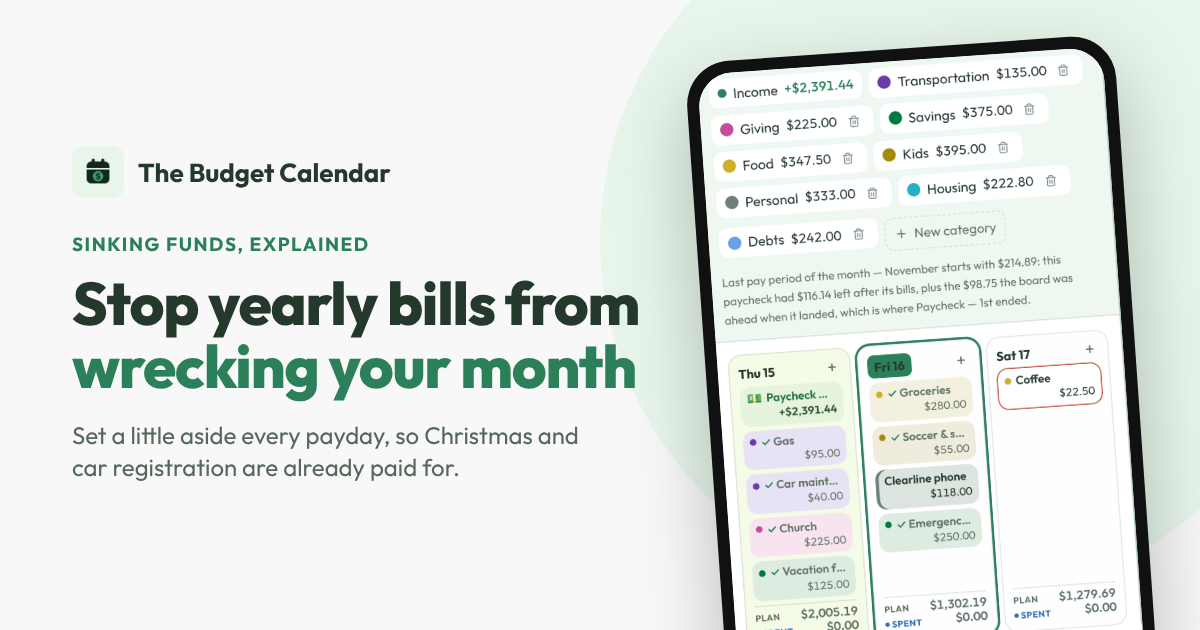
In The Budget Calendar, each savings goal sits on the paycheck that funds it, so you can see the $200 for Christmas leave on the 30th right next to the rent it has to share that paycheck with. The free plan includes up to three savings goals.
This is general information about budgeting methods, not financial advice. The Budget Calendar is not a financial adviser and cannot know your circumstances.